Hazelnut Fertilization Calendar: A Step-by-Step Guide from Post-Harvest to Spring
Short answer: Hazelnut fertilization falls into two main periods each year. Fertilizers rich in phosphorus and potassium are applied after harvest or in late winter (when the ground is not frozen); nitrogen fertilizers are applied in spring, at bud break and during nut cluster formation, usually split into two doses. Which fertilizer to apply and how much varies from orchard to orchard; the most accurate programme is prepared on the basis of a soil analysis.
In the Black Sea region, hazelnut is the most important source of income of the year for many families. Yet even within the same village, on the same slope, you can see orchards with very different yields. A large part of this difference comes from orchard care, and especially from whether fertilization is done at the right time with the right fertilizer. In this guide we explain, step by step, the year-round fertilization calendar for a hazelnut orchard, which nutrients matter most at each stage, and the practical points to watch.
Why Does Hazelnut Need Regular Fertilization?
Hazelnut is a perennial plant, and every year it produces both a crop and the shoots that will carry the following year's crop. Male and female flowers start to form during the previous year, before the summer in which the crop is harvested. In other words, this year's care affects not only this year's yield but also next year's yield.
The high rainfall of the Black Sea region, sloping land and generally acidic soils can make nutrients prone to leaching and make it harder for the plant to take up some elements (especially phosphorus). For this reason, a programme split and timed according to need is more efficient than "applying a lot of fertilizer once and leaving it".
Hazelnut's basic nutrient requirements
- Nitrogen (N): Needed for shoot growth, leaf area and nut cluster formation. With deficiency, leaves turn pale green to yellowish and shoots stay short.
- Phosphorus (P): Involved in root development, flower bud formation and energy metabolism. Its uptake can be difficult on acidic soils, where it can become fixed.
- Potassium (K): Linked to nut filling, kernel ratio and quality, as well as the plant's drought and cold tolerance.
- Sulphur (S), calcium (Ca) and micronutrients (especially zinc and boron): Can limit yield and quality in orchards where they are deficient.
Before Fertilizing: Soil Analysis Is Essential
Before moving on to the fertilization calendar, let us stress the most important step: soil analysis. The analysis shows the soil's pH, organic matter content, phosphorus and potassium levels and, if required, micronutrients. Without this information, fertilizer either falls short or turns into an unnecessary expense and a burden on the environment.
Practical recommendations:
- Take the soil sample after harvest and before fertilizing.
- Take sub-samples from 0–30 cm depth at different points in the orchard, under the canopy drip line of the clumps, and mix them.
- Sample sloping plots and plots with different characteristics separately.
- Have the analysis done at an accredited soil laboratory and evaluate the results with an agronomist.
- If the soil is very acidic, determine the liming requirement from the analysis results as well; do not lime and fertilize at the same time.
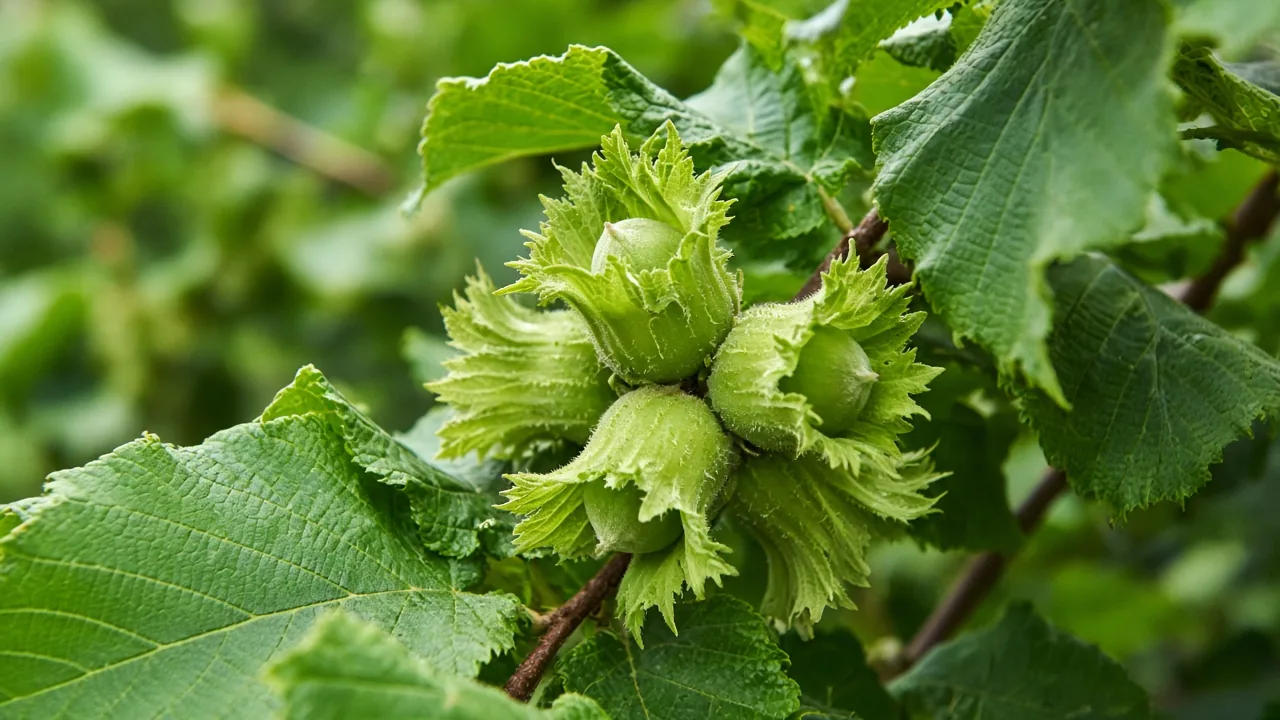
Hazelnut Fertilization Calendar: Stage by Stage
The calendar below is a general framework for Black Sea conditions. Depending on altitude, aspect, climate and soil, the dates may shift by a few weeks.
Stage 1: After harvest (late September – November)
The post-harvest period is when the plant recovers, nourishes next year's buds and continues root growth. Fertilizers rich in phosphorus and potassium come to the fore at this stage. Because phosphorus and potassium move more slowly in the soil than nitrogen, when applied in autumn or late winter they have time to reach the root zone with the rains.
- Suitable options: NPK 12-25-12+(15SO3)+ME is the compound fertilizer that stands out for post-harvest application in hazelnut. In orchards with a high potassium requirement, chloride-free Potassium Sulphate can be preferred.
- Organic matter support: On soils low in organic matter, Humic Acid (2–4 kg/da) can be added to the programme to support soil structure and nutrient uptake.
Stage 2: Late winter (February – early March)
If fertilization could not be done in autumn, phosphorus- and potassium-rich fertilizers can be applied in late winter, when the ground is not frozen or covered with snow. An application at this stage helps meet the needs of the plant as it wakes up in spring.
- Do not spread fertilizer when the ground is frozen, covered with snow or waterlogged; fertilizer can be lost through surface runoff.
- In orchards that need a balanced start, compound fertilizers such as NPK 15-15-15+(20SO3)+ME can be considered depending on the analysis results.
Stage 3: First spring nitrogen application (late March – April)
When the buds break and the shoots start to grow, the plant's nitrogen requirement increases. About half of the total nitrogen is applied at this stage.
- CAN 26 (26% N, 8% CaO) is widely preferred as a spring top-dressing for hazelnut. Its calcium content is an advantage, especially on acidic soils, and it does not acidify the soil as much as ammonium sulphate.
- In orchards with alkaline or neutral soil and a marked sulphur requirement, Ammonium Sulphate can be considered; however, because it can increase acidity on the already acidic soils of the Black Sea region, it should be used with care and pH should be monitored.
- Urea 46 contains a lot of nitrogen; incorporating it into the soil after application, or timing it before rain, reduces losses as ammonia.
Stage 4: Second spring nitrogen application (May – early June)
About a month after the first application, as nut cluster formation and nut development begin, the remaining nitrogen is applied. Splitting nitrogen in two reduces leaching losses during heavy rain and ensures the plant has access to nutrients when it needs them.
- At this stage, too, CAN 26 or a suitable nitrogen fertilizer according to the analysis results is generally used.
- Late nitrogen applications after mid-June are generally not recommended, as they can prolong shoot growth and delay wood ripening.
Summary calendar table
| Stage | Timing (approx.) | Key nutrients | Example AKFE products | Rate range on the product page |
|---|---|---|---|---|
| After harvest | Late September – November | Phosphorus, potassium | NPK 12-25-12+(15SO3)+ME, Potassium Sulphate | Potassium Sulphate: 15–30 kg/da |
| Organic support | Autumn or spring | Humic/fulvic acid | Humic Acid | 2–4 kg/da |
| Late winter (alternative) | February – early March | Phosphorus, potassium, sulphur | NPK 15-15-15+(20SO3)+ME, NPK 12-25-12 | According to analysis |
| First spring nitrogen | Late March – April | Nitrogen, calcium | CAN 26 | 20–35 kg/da |
| Second spring nitrogen | May – early June | Nitrogen | CAN 26 or Urea 46 | CAN 26: 20–35 kg/da; Urea 46: 15–25 kg/da |
The rate ranges in the table are general information from the product pages. The amount specific to your orchard should be determined by an agronomist according to the soil analysis, tree age, clump density and expected yield. The nitrogen rate is applied in split doses, not all at once.
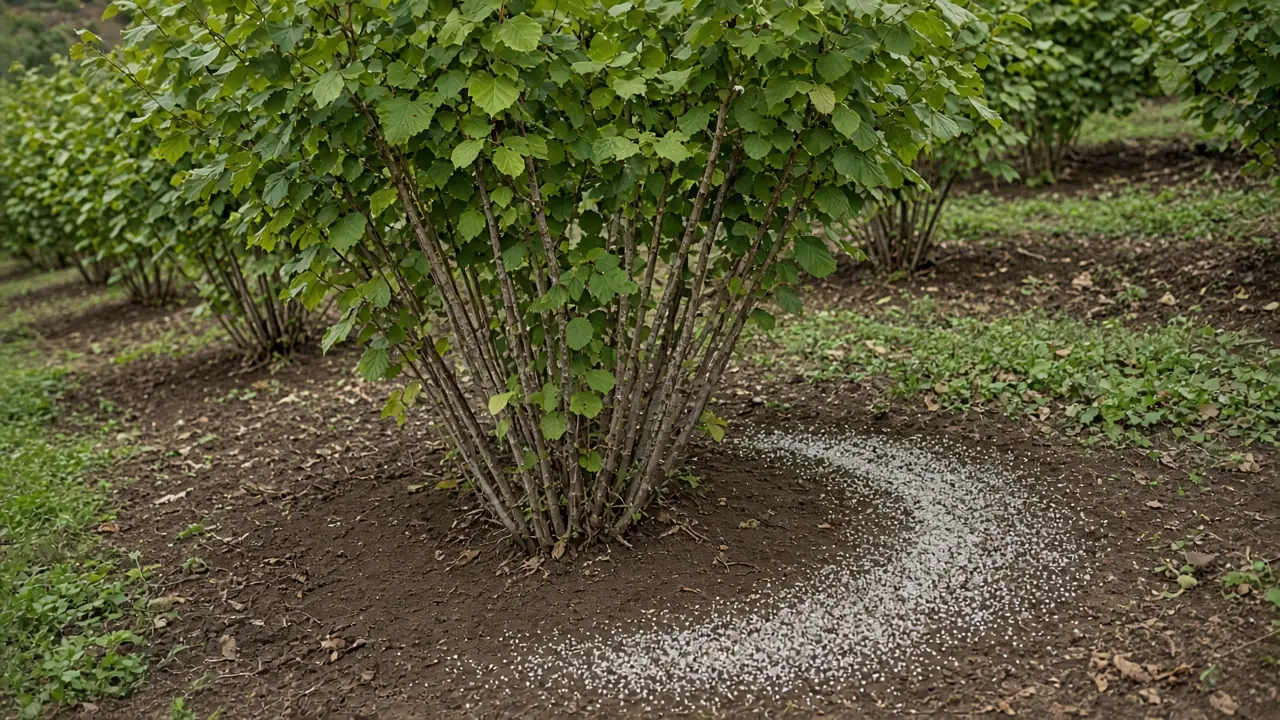
How to Apply Fertilizer: Practical Tips
How you apply fertilizer matters as much as applying the right fertilizer at the right time.
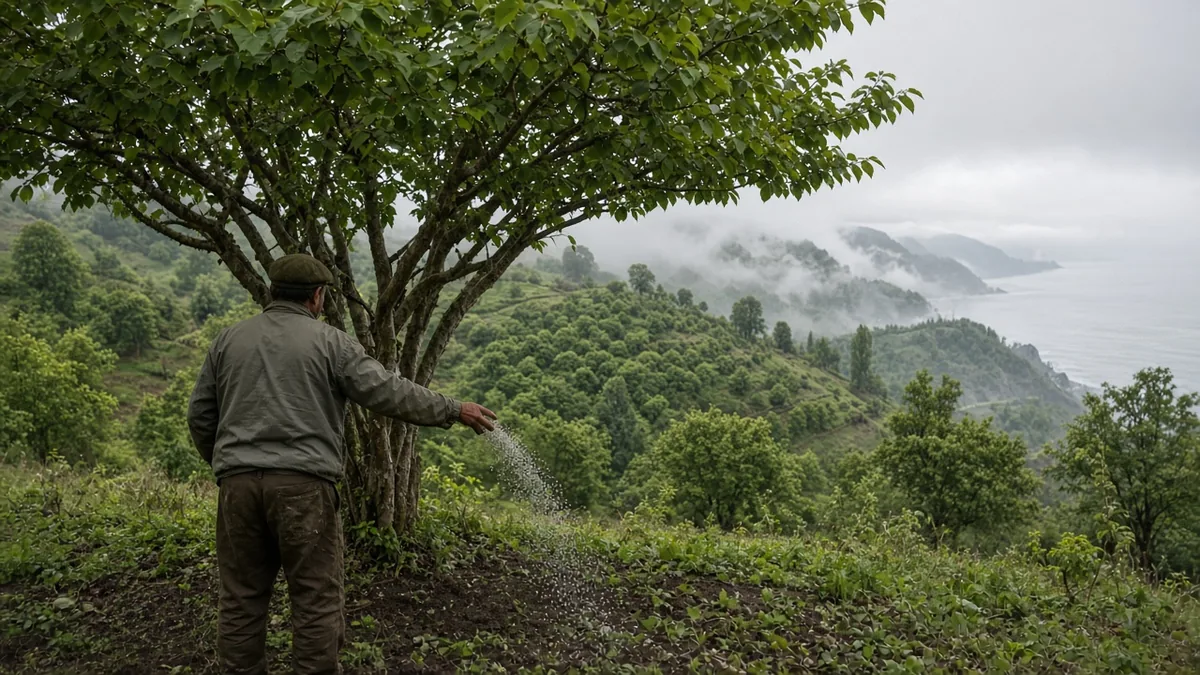
- Spread over the canopy drip line: Do not pile fertilizer at the base of the trunk. The feeding roots of hazelnut are concentrated under the area shaded by the branches. Spread the fertilizer evenly over this ring-shaped area.
- Lightly incorporate into the soil: Where possible, work it into the surface with a hoe; this reduces losses, especially with urea and phosphate fertilizers.
- Watch the weather: Do not spread fertilizer on days when heavy rain is expected, especially on sloping land. Application before light rain or when the soil is moist is more efficient.
- Weed control: Clearing weeds around the base of the clumps before fertilizing ensures that the nutrients go to the hazelnut.
- Keep records: Note which plot received how much of which fertilizer, and when. After a few years you will read your orchard's response much better.
Common Mistakes
- Applying all the fertilizer at once: Applying nitrogen in particular in a single dose can lead to serious losses with Black Sea rainfall.
- Always using the same fertilizer: Using only nitrogen fertilizer for years can cause phosphorus and potassium deficiency, and therefore a fall in kernel ratio and quality.
- Ignoring soil pH: On very acidic soils, part of the fertilizer applied cannot be used effectively. The liming requirement should be determined by analysis.
- High rates without analysis: Extra fertilizer does not increase yield proportionally; it increases cost and environmental risk.
- Late nitrogen application: Nitrogen applied after midsummer can delay wood ripening and pave the way for winter damage.
Conclusion
The key to a productive hazelnut season is preparing the orchard with phosphorus and potassium after harvest and in late winter, and in spring splitting nitrogen to match the periods when the plant needs it most. By combining this calendar with your own orchard's soil analysis and an agronomist's recommendations, you will manage both your yield and your fertilizer costs better.
Let us choose the right fertilizer for your orchard together. As AKFE Gübre, we deliver from Trabzon to all 81 provinces of Turkey. For CAN 26, NPK 12-25-12, Potassium Sulphate and our other products for your hazelnut orchard, contact us for a quote — phone: +90 462 325 05 41 / +90 531 474 78 85, email: satis@akfe.com.tr.
Frequently Asked Questions
When should hazelnut be fertilized?
In hazelnut, phosphorus- and potassium-rich fertilizers are applied after harvest (late September–November) or in late winter (February–early March). Nitrogen fertilizers are applied in spring, usually in two splits: late March–April and May–early June.
Which fertilizer is used for hazelnut?
Nitrogen fertilizers such as CAN 26 are widely used as a spring top-dressing, and compound fertilizers rich in phosphorus and potassium, such as NPK 12-25-12, after harvest. Where potassium is needed, chloride-free potassium sulphate can be preferred. The best choice is made on the basis of soil analysis.
How much fertilizer per decare should be applied to hazelnut?
The amount varies with the soil analysis, tree age and yield. The general ranges on the product pages are, for example, 20–35 kg/da for CAN 26, 15–25 kg/da for Urea 46 and 15–30 kg/da for Potassium Sulphate. Consult an agronomist for a rate specific to your orchard.
Why is nitrogen fertilizer applied to hazelnut in two splits?
Nitrogen moves quickly in the soil and can be lost through leaching in the heavy rains of the Black Sea region. Splitting it in two reduces losses and matches nitrogen to the shoot growth and nut cluster formation stages, when the plant needs it most.
Can ammonium sulphate be applied to hazelnut on acidic soil?
Ammonium sulphate has an acidifying effect on the soil. Because it can further increase acidity on the already acidic soils of the Black Sea region, it should be used with care and pH should be monitored regularly. On acidic soils, calcium-containing CAN 26 is usually the more suitable option.
Where around the clump should fertilizer be applied?
Fertilizer is spread evenly not at the base of the trunk, but under the area shaded by the branches, i.e. the canopy drip line. Lightly incorporating it into the soil where possible reduces losses.
How often should soil analysis be done in a hazelnut orchard?
As a general recommendation, it is useful to have a soil analysis done every few years, preferably after harvest and before fertilizing. More frequent analysis can be considered in orchards with problems or declining yields.