10 Key Points to Consider When Choosing Fertilizer
Short answer: To choose the right fertilizer, start with a soil analysis; then consider the crop and its growth stage, the fertilizer's NPK ratio and additional nutrients (SO3, ME, CaO), and soil pH and the crop's chloride sensitivity. Choose a granular or liquid form to suit your application method, calculate the rate on the basis of pure nutrient, and compare prices per unit of nutrient, not per bag. Finally, work with a supplier whose labels are complete, whose granules are uniform and who delivers on time.
Whether standing at the fertilizer dealer's or looking at a price list, the question on a farmer's mind is always the same: "Which fertilizer should I buy this year?" The fertilizer the neighbour used, last year's bag or price alone rarely gives the right answer. The wrong fertilizer wastes money and leads to losses in yield and quality. The following 10 points will help you make a systematic decision when choosing fertilizer.
1. Do Not Skip Soil Analysis
The first step in choosing a fertilizer is knowing what your soil needs. A soil analysis shows pH, salinity, lime, organic matter, phosphorus, potassium and, if required, micronutrient levels. Choosing without an analysis is like shooting in the dark: you may pay for nutrients that are already sufficient in the soil and overlook the ones that are missing.
We explain how to take a sample step by step in our article How to Do a Soil Analysis.
2. Define the Crop and Its Growth Stage
Every crop and every growth stage has different needs:
- Sowing/planting and the start of the season: Phosphorus-rich basal fertilizers come to the fore for root development.
- Rapid growth stage: Nitrogen top-dressings for shoot and leaf growth.
- Fruit filling and quality stage: Potassium takes priority.
For crop-specific programmes: Hazelnut Fertilization Calendar, Tea Garden Fertilization Guide, Wheat Fertilization Techniques.
3. Read the NPK Ratio and Additional Nutrients
The three numbers in a fertilizer's name show the percentage of nitrogen (N), phosphorus (P2O5) and potassium (K2O). SO3 next to the numbers indicates added sulphur, ME micronutrients and CaO calcium. Two fertilizers with the same NPK ratio can give different results because of these additional nutrients.
- Detailed label reading and rate calculation: How to Read a Fertilizer Label
- Balanced, phosphorus-rich and nitrogen-rich NPK types: What Is NPK Fertilizer?
4. Take Soil pH and Crop Sensitivities into Account
- Acidic soils (many hazelnut and tea areas in the Black Sea region): Continuous, high-rate use of fertilizers that acidify the soil further can lower pH. This is why calcium-containing CAN 26 is often preferred for hazelnut.
- Calcareous soils (many parts of Central Anatolia): Phosphorus and zinc uptake can become difficult; sulphur-containing fertilizers such as Ammonium Sulphate can help balance the soil reaction.
- Chloride sensitivity: For crops such as tobacco, citrus, grapes and hazelnut, chloride-free Potassium Sulphate is preferred; for chloride-tolerant field crops, Potassium Chloride is an economical option. Details: Potassium Chloride or Potassium Sulphate?
For the relationship between pH and fertilizer efficiency, see our article Soil pH and Fertilizer Efficiency.
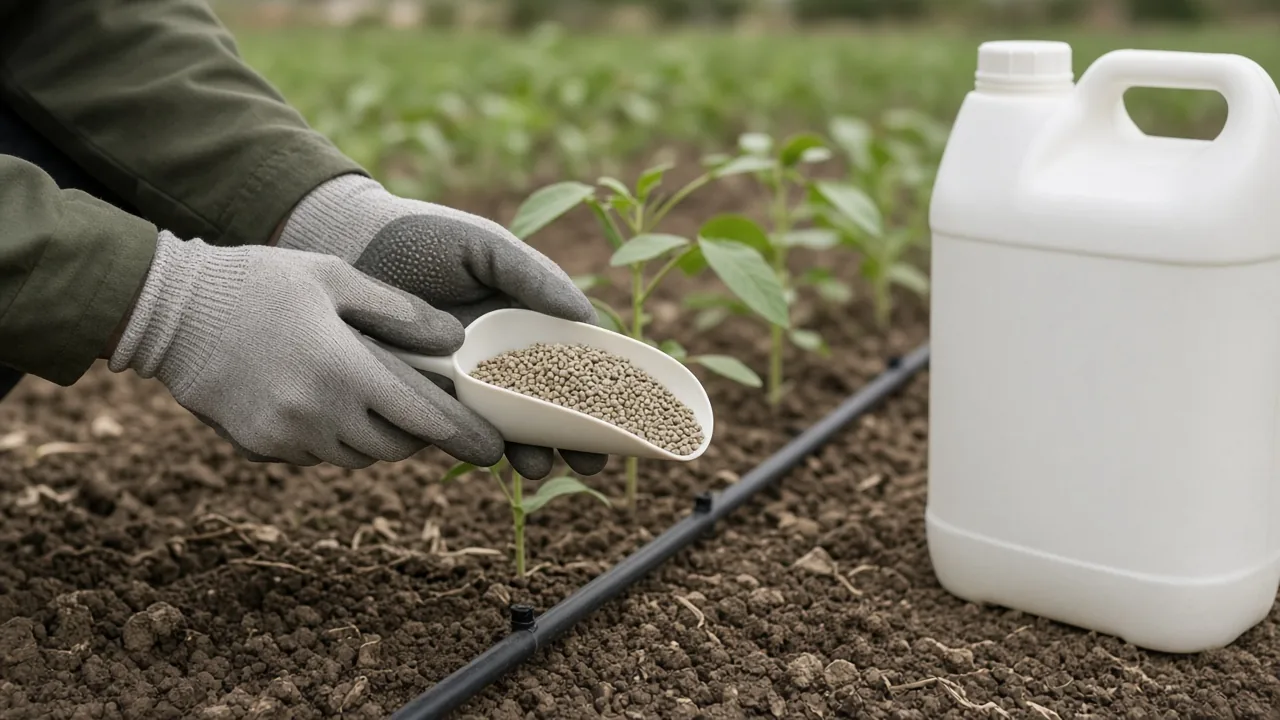
5. Granular or Liquid? Choose According to Your Application Method
| Criterion | Granular fertilizer | Liquid fertilizer |
|---|---|---|
| Suitable application | Broadcasting, basal placement with a seed drill, under the canopy in orchards | Drip irrigation (fertigation), sprinklers, foliar with appropriate dilution |
| Advantage | Practical, economical, easy to store | Uniform distribution, easy dosing, small and frequent doses |
| Watch out for | Spreader settings for even spreading; protection from moisture | Product compatibility, water analysis, system cleaning |
| AKFE examples | NPK 15-15-15+(20SO3)+ME, Urea 46, DAP 18-46-0 | UAN 32 + ME, Phosphoric Acid |
Note: Standard granular fertilizers are not "slow-release"; the nutrients become available as they dissolve in soil moisture. Slow release is a property of specially coated products.
6. See Organic and Mineral Fertilizers as Complementary, Not Competing
Farmyard manure, compost and soil conditioners improve soil structure and water and nutrient holding capacity in the long term. Mineral fertilizers supply the nutrients the plant needs in defined amounts and at defined times. The best results usually come from using both together, based on analysis. On soils low in organic matter, a soil conditioner such as Humic Acid can also complete the programme (general rate range on the product page: 2–4 kg/da), but it does not replace fertilizer.
7. Treat Application Timing as Seriously as the Fertilizer Itself
The right fertilizer applied at the wrong time will not have the expected effect:
- Phosphorus and potassium move slowly in the soil; they are usually applied at sowing or, in perennial crops, at the start of the season (autumn/late winter).
- Nitrogen is easily lost; it should be applied close to when the plant needs it and in split doses. Details: The Importance of Nitrogen Fertilizers in Agriculture.
- Avoid spreading fertilizer before a heavy downpour, especially on sloping land.
8. Calculate the Rate Correctly
Too much fertilizer can harm the plant (salt stress, scorch, lodging in cereals), while too little limits yield. For the right rate:
- Base it on the amount of pure nutrient (kg N, P2O5, K2O per decare) in the soil analysis and the expert recommendation.
- Divide this amount by the fertilizer's percentage to find the amount of product.
- Use the general ranges on the product pages as a starting point; for example, 30–50 kg/da for NPK 15-15-15+(15SO3)+ME and 30–40 kg/da for NPK 13-24-12+(10SO3).
9. Do Not Forget Sulphur and Micronutrients
Even when the primary nutrients are sufficient, a shortage of sulphur, zinc, boron or iron can limit yield and quality. Zinc and iron deficiencies are common on calcareous soils, and sulphur deficiency in some areas. If the analysis reveals a deficiency, consider fertilizers containing SO3 and ME, such as NPK 12-25-12+(15SO3)+ME or NPK 15-15-15+(20SO3)+ME, which contains 1% zinc. Because deficiency symptoms can look alike, act on analysis rather than guesswork.
10. Calculate Cost Correctly and Choose a Reliable Supplier
Cost per unit of nutrient: Compare two fertilizers not by bag price but by the cost of 1 kg of nutrient. A fertilizer that looks more expensive but contains more nutrients can be more economical per unit of nutrient.
What to check in a supplier:
- Is the label information — content (N, P2O5, K2O, SO3, ME), net weight and manufacturer details — complete and legible?
- Are the granules uniform, dry and dust-free? Are there any caked or wet bags?
- Is the packaging intact, or are there torn or punctured bags?
- Is technical support provided for product selection?
- Can delivery be made at a time that suits your application calendar?
Storing the fertilizer you receive in dry, proper conditions is just as important as choosing it: Fertilizer Storage Conditions.
Quick Checklist
| Question | Yes / No |
|---|---|
| Have I had a soil analysis done in the last 2–3 years? | |
| Do I know what my crop needs at this stage? | |
| Do the fertilizer's NPK ratio and additional nutrients match the analysis? | |
| Have I taken soil pH and chloride sensitivity into account? | |
| Is the form (granular/liquid) right for my application method? | |
| Have I calculated the rate on the basis of pure nutrient? | |
| Have I compared prices per unit of nutrient? | |
| Does the delivery time fit my application calendar? |
Conclusion
The right fertilizer is not the "most expensive" or the "best-selling" one; it is the one that matches the needs of your soil, your crop and your application period. Starting with a soil analysis and working through crop, stage, pH, form, rate, cost and supply in turn protects both your yield and your fertilizer budget.
Let us choose the right fertilizer together based on your analysis results. Consult the AKFE Gübre team; we will prepare a quote for the products and quantities you need. Delivery to all 81 provinces of Turkey — contact: +90 462 325 05 41 / +90 531 474 78 85, satis@akfe.com.tr.
Frequently Asked Questions
How do you choose the right fertilizer?
First, a soil analysis is done. The choice is then made by considering the crop and its growth stage, the fertilizer's NPK ratio and additional nutrients, soil pH, the crop's chloride sensitivity and the application method. The rate is calculated on the basis of pure nutrient.
What should you look out for when buying fertilizer?
Make sure the label content and net weight are complete, the granules are uniform and dry, and the packaging is intact; compare prices per unit of nutrient; and check that delivery fits your application calendar.
Should granular or liquid fertilizer be preferred?
It depends on the application method. For broadcasting and basal application with a seed drill, granular fertilizer is practical and economical. In fertigation systems such as drip irrigation and greenhouses, liquid fertilizers provide uniform distribution and easy dosing.
Can fertilizer be chosen without a soil analysis?
It can, but it is not recommended. Without an analysis, money may be spent on nutrients that are already sufficient in the soil, or a missing nutrient may be overlooked. Analysis is the most reliable way to manage a fertilizer budget properly.
How should I compare fertilizer prices?
Instead of the bag price, compare the cost of 1 kg of nutrient (N, P2O5 or K2O). To do this, simply divide the bag price by the amount of pure nutrient in the bag.
Is the same fertilizer applied to every crop?
No. Crops differ in their nutrient needs, growth stages and sensitivities. For example, chloride-free potassium sources are preferred for chloride-sensitive crops, and calcium-containing nitrogen fertilizers on acidic soils.