The Importance of Nitrogen Fertilizers in Agriculture: Why Do Plants Need Nitrogen So Much?

Short answer: Nitrogen (N) is a building block of chlorophyll, proteins and enzymes, so it directly governs a plant's leaf, shoot and green growth. Nitrogen deficiency shows up as yellowing that starts on the older leaves, stunted growth and low yields; too much nitrogen causes excessive vegetative growth, lodging, susceptibility to disease and delayed ripening. Nitrogen is the nutrient most easily lost from the soil, so nitrogen fertilizers should be applied with the right source, at the right rate, at the right time and in the right way, usually as split applications.
The moment you see a crop in the field or orchard "pick up and green up", you are usually seeing the effect of nitrogen. Nitrogen is the nutrient plants need in the largest amounts, and its deficiency is the quickest to notice. At the same time, it is also the nutrient that is most easily lost and that harms both your budget and the environment when misused. In this article we explain the role of nitrogen in the plant, what happens to it in the soil, and what to pay attention to in order to get the best return from nitrogen fertilizers.
If you would like to compare the different nitrogen fertilizers one by one, see our article Nitrogen Fertilizers: Types and Uses.
What Does Nitrogen Do in the Plant?
Nitrogen is an essential element that is built directly into the plant's structure:
- Chlorophyll: Nitrogen is part of chlorophyll, which gives leaves their green colour and drives photosynthesis. When nitrogen is short, photosynthesis, and therefore growth, slows down.
- Proteins and enzymes: All proteins in the plant and the enzymes that control growth contain nitrogen. In wheat, grain protein content is also largely linked to nitrogen nutrition.
- Shoot and leaf growth: Adequate nitrogen means a large leaf area and vigorous shoots. New shoot (flush) formation in tea, shoot and husk cluster development in hazelnut, and tillering in cereals all depend on nitrogen.
- The basis of yield: The healthier the leaf area, the more energy the plant can transfer to fruit, grain and tubers.
How to Recognise Nitrogen Deficiency
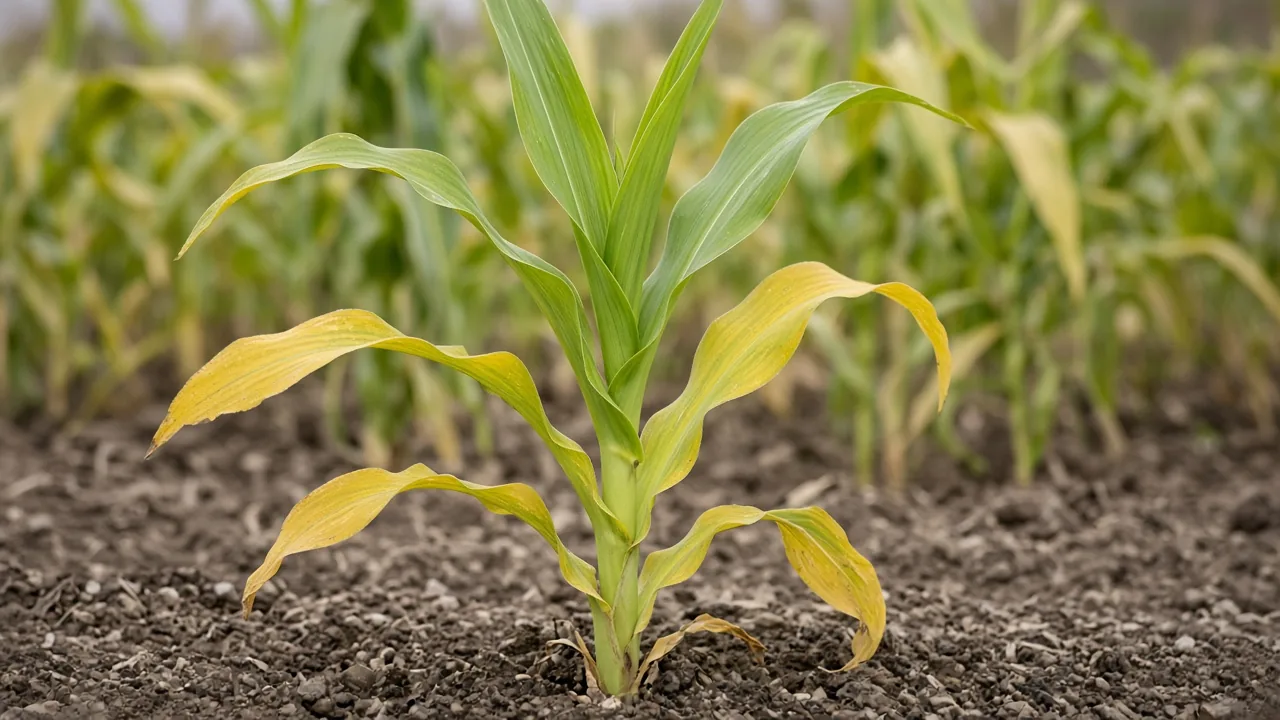
Nitrogen is mobile within the plant. When the plant cannot take up enough nitrogen, it moves nitrogen from older leaves to younger ones. That is why symptoms appear first on the lower, older leaves:
- Pale green, then yellow colour on older leaves; in maize, a "V"-shaped yellowing from the leaf tip along the midrib
- Weak, short shoots and small leaves
- In cereals, poor tillering and short ears with few grains
- In fruit trees, weak shoots, small fruit and early leaf drop
- In tea, a drop in the number and quality of new shoots
Note: Yellowing does not always mean nitrogen deficiency. With sulphur deficiency, yellowing starts on the young leaves; heavy rain, waterlogging, cold or root diseases can also look similar. Rather than guessing, the right approach is to diagnose with soil analysis and, where needed, leaf analysis.
The Harm Caused by Excess Nitrogen
The idea that "more fertilizer means more yield" is especially misleading for nitrogen. Too much nitrogen:
- Leads to excessively lush, soft growth and lodging in cereals.
- Makes the plant more exposed to diseases and pests (especially aphids and fungal diseases).
- Delays ripening and can reduce fruit colour and storage quality.
- In hazelnut, can cause excessive vegetative growth, with energy going into leaves instead of nut clusters.
- Unused nitrogen can reach groundwater as nitrate; this is both a financial loss and an environmental problem.
How Does Nitrogen Behave in the Soil?
Nitrogen applied with fertilizer is converted into different forms in the soil. Plants take up nitrogen mainly as nitrate (NO3-) and ammonium (NH4+).
| Nitrogen form | Behaviour in the soil | Found in |
|---|---|---|
| Urea (amide) | First converts to ammonium in the soil; if left on the surface it can be lost as ammonia | Urea 46, UAN 32 |
| Ammonium | Held by soil particles and leached more slowly; gradually converts to nitrate | Ammonium Sulphate, CAN 26, UAN 32 |
| Nitrate | Immediately available and fast-acting; moves easily with water and can be leached | CAN 26, UAN 32 |
How is nitrogen lost?
- Volatilisation (ammonia loss): If urea is spread on the soil surface and not incorporated, losses increase, especially in hot, windy weather and on calcareous soils.
- Leaching: Nitrate moves below the root zone with rain or over-irrigation. This risk is pronounced on the high-rainfall, sloping land of the Black Sea region.
- Denitrification: In waterlogged, poorly aerated soils, nitrate is lost to the atmosphere as gas.
- Surface runoff: On sloping land, fertilizer left on the surface just before a downpour can be washed away.
4 Rules for Using Nitrogen Fertilizer Efficiently
1. The right source
The nitrogen source is chosen according to soil pH, the crop and the application method. For example, CAN 26, which also contains calcium, may stand out on acidic Black Sea soils; ammonium sulphate for sunflower and cereals with a sulphur requirement, or for tea; and liquid UAN 32 for drip irrigation. For the relationship with pH, see our article Soil pH and Fertilizer Efficiency.
2. The right rate
The rate is determined by the crop, the expected yield, the previous crop, organic matter and the results of a soil analysis. The general ranges on AKFE product pages can be used as a starting point:
| Product | Nitrogen content | General rate range on the product page |
|---|---|---|
| Urea 46 | 46% N | 15–25 kg/da |
| CAN 26 | 26% N, 8% CaO | 20–35 kg/da |
| Ammonium Sulphate | 21% N, 24% S | 25–40 kg/da |
| UAN 32 + ME | 32% N (liquid) | 5–10 L/da |
These ranges are general information (1 da = 0.1 ha); analysis and expert advice are essential for a rate specific to your orchard or field. To convert the percentage on the bag into pure nitrogen, see the calculation examples in our article How to Read a Fertilizer Label.
3. The right time
Nitrogen should be applied close to the period when the plant needs it most. Applying the total nitrogen as split doses reduces losses:
- Cereals: Part at sowing (with the basal fertilizer), the rest at tillering and stem elongation. Details: Wheat Fertilization Techniques.
- Hazelnut: Two splits in spring, at bud break and during nut cluster formation. See Hazelnut Fertilization Calendar.
- Tea: Split applications before the first flush and between harvests. See Tea Garden Fertilization Guide.
- Greenhouse and vegetables: Small, frequent doses through fertigation.
4. The right method
- Where possible, incorporate urea into the soil or time it just before light rain or irrigation.
- Do not spread fertilizer on sloping land when a heavy downpour is expected.
- Spread fertilizer over the zone where roots are concentrated (in orchards, the canopy drip line), not against the trunk.
- Avoid granular fertilizer touching wet leaves; it can cause leaf scorch.
Conclusion
Nitrogen is the engine of yield; but like an engine's fuel, if it is not supplied in the right amount at the right time, it either falls short or is burned for nothing. Splitting nitrogen applications while taking into account the crop's seasonal needs, your soil pH and rainfall conditions protects both your yield and your fertilizer budget. Above all, build your programme on a solid foundation by having a soil analysis done.
Let us work out together which nitrogen fertilizer suits your crop and soil. Get a quote from the AKFE Gübre team for products and quantities; delivery to all 81 provinces of Turkey — contact: +90 462 325 05 41 / +90 531 474 78 85, satis@akfe.com.tr.
Frequently Asked Questions
What does nitrogen do in plants?
Nitrogen is part of chlorophyll, proteins and enzymes. It directly affects leaf and shoot growth, photosynthesis and therefore yield. In cereals, tillering and grain protein are also linked to nitrogen.
What are the symptoms of nitrogen deficiency?
With nitrogen deficiency, pale green and yellow colouring appears first on the older, lower leaves; the plant stays stunted and shoots are shortened. In cereals, tillering is reduced. Since similar symptoms can have other causes, diagnosis by analysis is recommended.
What happens if I apply too much nitrogen fertilizer?
Excess nitrogen can lead to excessive green growth, lodging in cereals, susceptibility to diseases and pests, delayed ripening and lower fruit quality. Unused nitrogen can be leached into groundwater.
Why is nitrogen fertilizer applied in split doses?
Nitrogen is easily lost from the soil through volatilisation, leaching and denitrification. Splitting the total rate across the periods when the plant needs it reduces losses and allows the plant to use nitrogen more efficiently.
Why should urea be incorporated into the soil?
If urea stays on the surface, it can turn into ammonia and be lost to the air; this loss increases in hot, windy weather and on calcareous soils. Incorporating it into the soil, or applying it before light rain or irrigation, reduces the loss.
When should nitrogen fertilizer be applied?
It is applied during periods of rapid growth: at sowing, tillering and stem elongation in cereals; at spring bud break and nut cluster formation in hazelnut; and during flush periods in tea. The exact timing and rate are determined by soil analysis.